With the sea turtle nesting season on Florida’s Space Coast beaches well underway, Brevard officials have recognized an uptick in disturbance from humans. Space Coast beaches are among the most important nesting grounds for sea turtles in the world. Every year, tens of thousands of sea turtle nests are laid just within the Archie Carr National Wildlife Refuge, a 20.5 mile stretch of beach in Brevard and Indian River counties. Due to the high level of nesting density here, survival threats can have an outsized impact. These threats include deaths of hatchlings misdirected from poorly managed coastal lighting and disturbance and entrapment of female turtles attempting to nest at night.
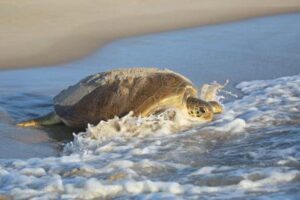
Throughout the month of June, Brevard County has recorded a higher-than-normal number of adult sea turtle disorientations on Melbourne Beach, Indiatlantic, Satellite Beach, and in unincorporated areas. On multiple occasions, sea turtles have crawled hundreds of feet on the beach, parallel to the water, before eventually making it back to sea. Many of these instances resulted in a false crawl, where the female abandoned her nesting attempt. A few turtles have also crawled up over the dune and needed assistance from researchers back to the water. These signs in the sand indicate that a turtle had been interfered with by beachgoers at night, disoriented by poorly managed lights, or a combination of both. Beach surveyors have also found chairs, canopies, and recreational equipment left overnight by beach visitors. These have been shown to obstruct turtles’ nesting attempts and even entrap nesting turtles.
Any artificial light source, especially white, unshielded lights on the beach can cause sea turtles to crawl toward those lights (misorient) or crawl in circles on the beach (disorient). Lights from cell phones, flashlights, campfires, and lanterns are also problematic for sea turtles. In Brevard County, these lights have the potential to impact thousands of sea turtles each night, which can result in a turtle not being able to complete the nesting process, and could result in the death of hatchlings. Nesting turtles spending more time crawling along beaches may burn up important fat stores needed to producing subsequent clutches of eggs during the season. Disoriented hatchlings also use up valuable energy stores that they need to make it sea, are made more vulnerable to predators, and could die of exhaustion or dehydration.
From now until the fall, thousands of sea turtle nests will be laid and will hatch in Brevard County. The Coastal Lighting Impacts Coalition (CLICk) encourages residents and visitors to help ensure that the area’s federally-protected sea turtles make it safely back to sea.
Recommendations from CLICk on how residents and visitors can protect sea turtles include:
- Leaving transient lights, such as flashlights, at home.
2. Turning off all exterior lights visible from the beach, drawing curtains, and using window tinting (30% visual light transmittance or lower) during nesting season. Brevard County’s coastal lighting ordinance is in effect from May 1 through October 31.
3. Filling in holes dug in the sand before leaving the beach.
4. Taking home all beach furniture, trash, and toys from the beach.
5. Giving sea turtles space on the beach. Harassing, harming, or interfering with sea turtle behavior on the beach is prohibited by state and federal law. Keep sea turtles safe by giving them at least 50 feet of space.
CLICk comprises scientists, resource managers, and nonprofit organizations throughout the State, all concerned with coastal threats from light pollution.
For more information, contact:
Rachel Tighe, Sea Turtle Conservancy, rachel@conserveturtles.org, 352-373-6441
Merope Moonstone, Brevard County, merope.moonstone@brevardfl.gov, 321-515-3441
Latest Articles


STC Awarded Three Florida Sea Turtle License Plate Grants in 2026